


More Than a Wave: South Beach, Miami’s Marine Park and the Surf Ecosystem Beneath It

Sometimes science catches up with something surfers have understood intuitively for generations:
A wave is never just a wave.
A recent SURFER article, “Your Local Surf Break Is Part of Something Much Bigger,” highlighted new research from Save The Waves Coalition introducing the idea of a surf ecosystem, a way of looking beyond the single breaking wave and recognizing everything that helps create it.
The swell. The seafloor. Reefs. Sand. Currents. Water quality. Coastal structures. Wildlife.
And even the people who surf, swim, dive, fish, paddle and care for that place.
Change one piece of that interconnected system, and you may eventually affect another.
For us at Surf Skate Science, there may be no better place to explore that concept than one of South Florida’s most unusual surf breaks:
South Beach.
And now, the proposed Miami Beach Marine Park and the growing REEFLINE project are giving us an even bigger reason to look beneath those waves.

Why Does South Beach Pump When So Much of Florida Doesn't?
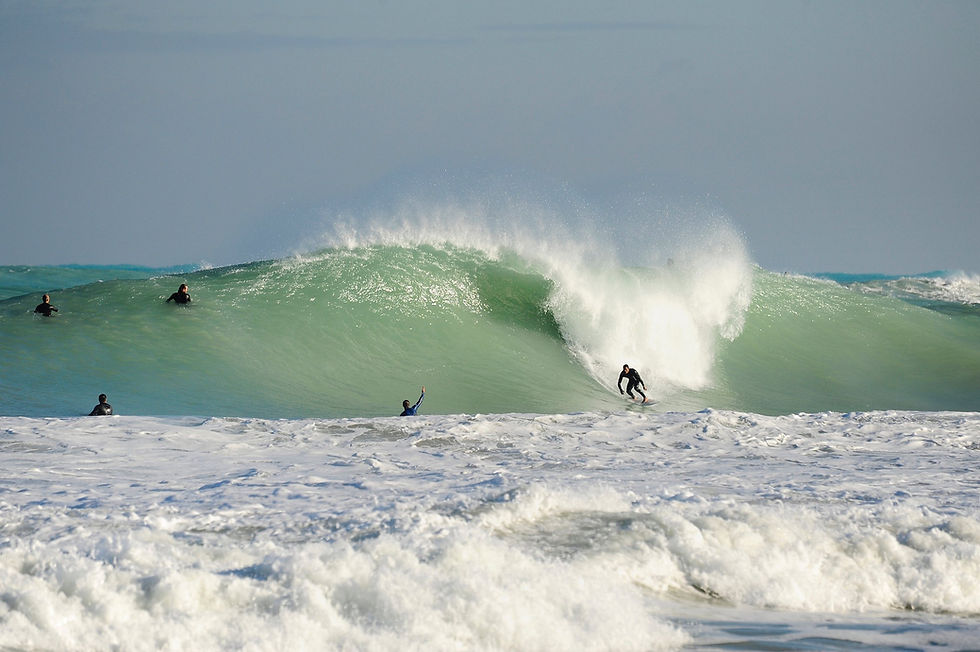
Anyone who surfs Miami knows the contradiction.
South Beach can look more like a swimming pool than a surf destination for weeks at a time.
Then the right winter storm sends the right swell at the right angle and suddenly South Beach can produce fast, hollow, overhead barrels.
Surfline calls South Beach one of the East Coast’s best—but also one of its most fickle—barreling waves. Their forecasters note that it takes a very particular set of conditions for Miami to receive clean, overhead surf.
Their South Beach surf guide goes even further.
During large north and northeast swells, South Beach can actually become one of the few places in Florida producing significant surf. Surfline notes that nearly due-north, or roughly zero-degree, swells can sometimes bypass much of Florida's coastline while still reaching Miami.
That sounds backward.
Shouldn't Miami, at the very bottom of the peninsula, get less northern swell?
That's exactly what makes this such a fascinating physics lesson.
The Coastline Changes the Equation
South Beach faces more toward the southeast than beaches farther north in Florida.
When very northerly swell energy reaches this part of the coast, the waves approach at an unusual angle. As they move into progressively shallower water, that energy refracts, essentially bending as different portions of the wave slow at different rates.
Surfline describes how these northerly swells bend into South Beach and can produce powerful right-breaking waves over the shallow, compacted sandbars.
On the right swell, the result can be dramatic:
energy traveling across the Atlantic suddenly concentrates into steep, hollow surf along a beach that may have been nearly flat shortly before.
And the swell direction has to be remarkably precise.
South Beach has what surfers call a narrow swell window. Move that swell direction, wind, tide or storm track just enough and the magic can disappear. Surfline even describes the experience of catching a perfect barrel, paddling back out, and finding that what appeared to be a pumping ocean has almost suddenly gone quiet.
That is a spectacular real-world demonstration of wave physics.
Then Add Government Cut
At the southern edge of South Beach is another major piece of this system:
Government Cut.
The shipping channel and South Pointe jetty create a dramatically altered coastal environment beside the surf break.
Government Cut provides deep-water access between the Atlantic and PortMiami, while the rock jetty creates a fixed boundary at the southern end of the beach.
Those structures matter because waves do not respond only to weather.

They respond to bathymetry, the shape and depth of the seafloor beneath them.
As waves move from deeper water into shallower water, they slow, refract, steepen and eventually break. Sandbars, reef structures, dredged channels and other underwater contours can all influence how wave energy arrives at shore.
That means South Beach isn't simply the product of "a big storm offshore."
It is the result of a much larger equation:
storm + swell direction + wave period + wind + tide + coastline orientation + bathymetry + sandbars + coastal engineering.
That is precisely why altering the underwater landscape near an established surf break deserves careful consideration.

The Bahamas Make Miami Surf Even Stranger
There is another giant piece of the South Florida wave puzzle sitting just offshore:
The Bahamas.
The islands and shallow banks east of Florida block or weaken much of the Atlantic swell energy that would otherwise travel toward Southeast Florida.
That's a major reason Miami does not receive the consistent open-ocean surf found in other parts of the Atlantic coast.
South Beach needs the right swell to find its way around that geographic obstacle course.
And when a strong, unusually northerly swell reaches Miami at just the right angle, South Beach can become the catcher's mitt.
In a previous Surfline account of an exceptional South Beach swell, the site described zero-degree north swell as bypassing much of the Sunshine State while South Beach picked up the energy.
So what looks like a single breaking wave near the jetty actually began as energy created far away and then transformed by geography over an enormous distance.
That's a surf ecosystem in action.

And Beneath Those Waves Is Another Ecosystem
Now look underwater.
Just offshore from one of the most heavily visited urban beaches in the world is a living nearshore marine environment.
The proposed Miami Beach Marine Park seeks to recognize and protect this area as one connected marine resource.
The community-led proposal encompasses the South Pointe area, the nearshore reef system including Neon Reef, and surrounding habitat.
This isn't a remote reef accessible only through a long offshore boat ride.
Parts of this marine environment can be reached directly from one of America's most famous beaches.
Imagine standing there with students and being able to say:
The reef you're snorkeling over, the sand under your feet, the wave breaking beside you, the fish below you and the city behind you are all parts of the same system.
That's an outdoor science laboratory almost impossible to reproduce indoors.
Then Came REEFLINE
Adding another layer to the story is REEFLINE, an underwater public-art and artificial-reef project being constructed offshore of Miami Beach.
The vision combines art, reef habitat, coral restoration and public access.
Its first major deployment included Leandro Erlich's Concrete Coral: 22 life-sized automobile forms constructed from marine-grade concrete and installed underwater. The structures are designed to become habitat and support future coral growth.
REEFLINE plans eventually call for underwater installations stretching north along Miami Beach. (Read more here)
That creates an extraordinary intersection:
natural reef + artificial reef + public art + marine science + coral restoration + surfing + tourism + engineering + education.
But initially, surfers saw a potential problem.
What Happens When Reef Restoration Meets a Surf Break?
When REEFLINE was first proposed, members of Miami's surfing community became concerned that adding large structures to the seafloor near South Beach could change the wave.
And from a scientific standpoint, that's not an unreasonable question.
If bathymetry helps shape a surf break, then deliberately changing bathymetry has the potential to change how waves propagate.
Surfrider Foundation's Miami Chapter formally became involved after surfers raised concerns in 2020 about possible impacts to the iconic South of Fifth surf break.
Surfrider scientists and local chapter leaders began negotiating with the REEFLINE team and challenged the project's permit while the two sides worked toward an agreement.
Then something important happened.
Miami Beach Marine Park, Reefline and Surfrider Miami found a compromise.
In October 2021, Surfrider and REEFLINE reached an agreement intended to protect the South Beach wave.
Under the resolution, the project agreed that its installations would not extend south of Fourth Street, creating separation between REEFLINE structures and the primary South of Fifth surf zone. The developer also agreed to fund University of Miami research examining possible impacts on wave behavior.
Researchers subsequently found no significant modeled change in wave height from the project configuration they studied. Surfrider described that result as encouraging while also noting an important limitation: the analysis did not fully address longer-term changes involving sand transport and accretion.
That nuance matters.
Science doesn't always give us a simple:
YES, SAFE.
or
NO, BAD.
Sometimes science gives us:
Here is what we measured. Here is what the evidence currently suggests. And here is what we still need to watch.
That may be one of the most valuable lessons in this entire project.
This Is What Environmental Stewardship Can Look Like
We love this part of the South Beach story because the outcome did not have to become:
Surfers versus environmentalists.
It didn't have to be:
Recreation versus conservation.
Or:
Art versus science.
Surfrider is itself an ocean-conservation organization.
REEFLINE is trying to create marine habitat.
The surfers were trying to protect a rare coastal resource.
All of those things can matter at once.
The process instead became an example of stakeholders asking:
How can we restore one part of an ecosystem without unintentionally damaging another?
That's exactly how we want students to think.
Protect the Reef. Protect the Wave. Protect the Whole System.
The new Save The Waves research gives us language for this.
A surf break isn't simply the patch of water where someone stands up on a board.
It exists because multiple physical, ecological and social systems overlap.
That means conserving a wave can involve protecting things far beyond the takeoff zone.
Water quality matters.
Coral matters.
Sand movement matters.
Bathymetry matters.
Coastal engineering matters.
Public access matters.
Marine life matters.
And yes—
surfing matters too.
Protecting one part while ignoring everything around it misses the point.
South Beach Could Become One Incredible Living Classroom
This is where the proposed Miami Beach Marine Park becomes especially exciting for us at Surf Skate Science.
Imagine taking students into one relatively small section of coastline and investigating:
PHYSICS
Why does South Beach remain flat so often but occasionally produce heavy barrels?
How does swell direction affect whether Miami gets waves at all?
Why does a wave refract when it encounters shallower water?
ENGINEERING
How did dredging Government Cut change the coastal environment?
How does a jetty influence water and sediment movement?
How can engineers design artificial reefs without adversely affecting nearby surf?
MATH
Can students use wave period, wavelength, direction and bathymetric data to predict where waves will break?
BIOLOGY
What organisms live on Neon Reef?
What species begin colonizing newly deployed reef structures?
CHEMISTRY
How do temperature, salinity, dissolved oxygen, nutrients and pH influence coral and marine organisms?
ENVIRONMENTAL SCIENCE
How do coral reefs, waves, sediment and shorelines interact?
What happens when anchors, pollution or excessive human use damage a nearshore reef?
ART + DESIGN
Can a sculpture become functional habitat?
Can art change the way people think about an ecosystem they cannot normally see?
CIVICS
Who decides what happens in public ocean space?
What happened when surfers felt a public project threatened their break?
How did advocacy, science and compromise change the final plan?
That last one may be among the most important.
Students don't only get to study a reef.
They get to study how communities make decisions about a reef.
WHAT → SO WHAT → NOW WHAT?
This entire place fits beautifully into the way we believe students learn.
WHAT? — Explore It
Watch the waves.
Snorkel the reef.
Measure the water.
Investigate the sand.
Look at the jetty.
Study the artificial reef.
Learn the physics behind the swell.
SO WHAT? — Connect It
Why does any of this matter?
Because changing one piece of a coastal system can affect another.
Because a coral reef has ecological value.
Because a surf break has cultural and recreational value.
Because public access has value.
Because Miami's coastline belongs to more than one interest group.
NOW WHAT? — Use It
Test the water.
Document reef health.
Study changes over time.
Create art.
Educate visitors.
Advocate when something needs protection.
Become part of the solution.
Because a Surf Break Is Never Just a Surf Break
Think about what has to happen before someone catches one perfect South Beach barrel.
A storm creates energy far from Miami.
That swell begins traveling across the Atlantic.
The geography of the Bahamas determines which portions of that energy can reach Southeast Florida.
Swell direction determines whether South Beach catches it.
The coastline bends it.
The seafloor transforms it.
Sandbars shape it.
The tide changes it.
Wind cleans it up—or destroys it.
Then, for a few seconds, all of those variables come together.
A surfer paddles.
The wave stands up.
And the entire invisible system suddenly becomes visible.
Below that surfer may be reef habitat, fish and corals.
Nearby are divers, swimmers and fishermen.
Offshore are ships entering Government Cut.
Onshore is one of America's densest urban and tourism environments.
And now another layer—marine restoration and underwater public art—is being added to that system.
It is all connected.
That's why we are excited about the proposed Miami Beach Marine Park.
Not because we're interested only in coral.
And not because we're interested only in surfing.
We're interested in the relationship between them.
South Beach gives Miami an extraordinary opportunity to protect and study an entire coastal system while teaching the next generation something bigger:
The ocean doesn't separate physics from biology, engineering from environmental science, art from conservation, or recreation from stewardship.
Neither should we.
At Surf Skate Science, that's exactly where some of the best learning happens.
We've got awesome down to a science.


Great survey, I'm sure you're getting a great response. keep bloggin sir ginger ale